Introduction
Preschool shape tracing worksheets free resources provide foundational geometric practice and fine-motor skill development for early childhood learners without requiring financial investment from educators. According to the National Association for the Education of Young Children (NAEYC), developmentally appropriate practice integrates playful manipulative exploration with structured visual-motor exercises to build essential pre-writing coordination. High-quality printables serve as a critical bridge between unstructured artistic expression and formal handwriting mechanics. Practitioners seeking structured foundational materials frequently explore Worksheets and Handwriting & Tracing collections to build comprehensive skill sequences.
Curriculum Practice Snapshot:
- Core Focus: Early geometry recognition and fine-motor pencil control utilizing no-cost printable templates.
- Target Scope: Pre-kindergarten and early childhood developmental classrooms (ages 3 to 5).
- Key Recommendation: Pair static paper tracing with tactile manipulatives to reinforce spatial memory and muscle coordination.
Core Principles and Detailed Overview
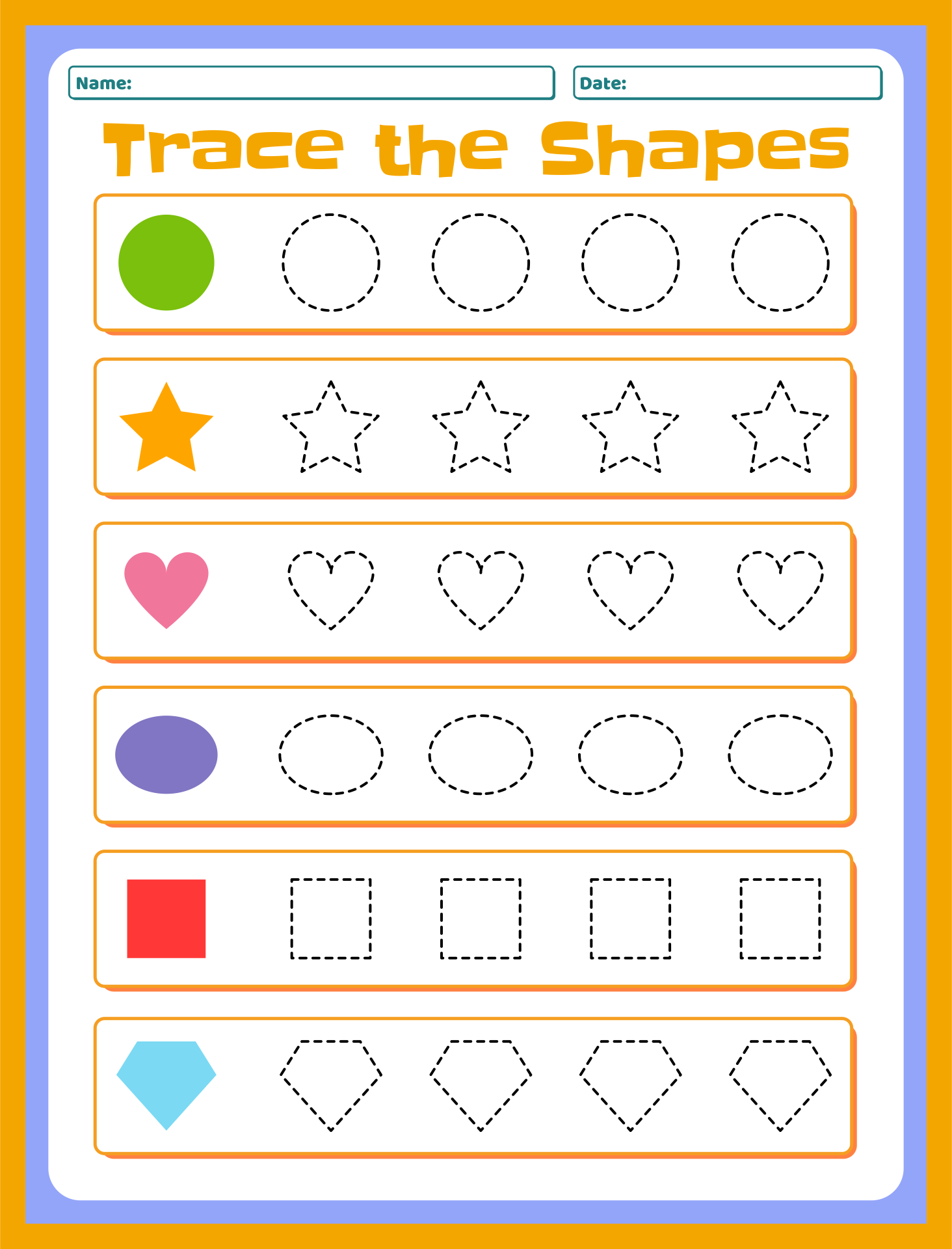
Shape tracing sheets bridge visual spatial awareness with physical motor output by requiring children to follow dotted directional pathways that outline fundamental geometric figures. Direct motor planning occurs as tiny hands coordinate eye movement with pencil grip to navigate corners, curved arcs, and intersecting lines. These printable exercises directly support early geometry standards by helping young learners identify, name, and reproduce basic shapes such as circles, squares, triangles, and rectangles. Integrating these geometric practice sheets alongside broader Learning Activities ensures a balanced multisensory instructional approach.
Key Specifications and Breakdown
| Grade / Developmental Stage | Target Learning Skill | Instructional Strategy & Scaffolding |
|---|---|---|
| Early Preschool (Ages 3-4) | Basic Continuous Curves (Circles) | Use thick dashed lines, large shapes, and directional starting arrows. |
| Mid Preschool (Ages 4-5) | Straight Lines and Corners (Squares) | Transition to medium line weights with visual corner stop-points. |
| Advanced Pre-K (Ages 5-6) | Complex Angles (Triangles/Diamonds) | Implement independent dot-to-dot guides and partial shape completion prompts. |
Early childhood motor skill acquisition requires systematic, scaffolded practice balancing visual discrimination with tactile execution — What Works Clearinghouse (IES)
Step-by-Step Practical Application and Guidelines
Implementing shape tracing exercises effectively requires a progressive instructional sequence starting with large-scale tactile exploration before transitioning to standard paper-and-pencil tasks. Educators first demonstrate proper pencil grip while modeling the continuous hand motion required to draw a specific shape, emphasizing the starting point and directional arrows. Children subsequently trace the shapes using thick crayons or markers to reduce resistance before advancing to standard pencils. Supplementary creative enhancements, such as accompanying Coloring Pages, help maintain engagement and reinforce shape identification in varied visual contexts.
Common Challenges and How to Avoid Them
Premature expectations regarding pencil grip and angular precision often cause frustration during early geometric tracing sessions. Educators prevent student fatigue by limiting worksheet duration to short, five-minute intervals and prioritizing correct hand posture over flawless line adherence. Providing varied line thicknesses and oversized shapes accommodates developing visual-motor control levels, ensuring all children experience steady progress without unnecessary strain.
💬 Frequently Asked Questions
Explore More Early Learning and Classroom Resources on Knowalla
Curators, educators, and families can discover an extensive selection of instructional aids, printable activities, and foundational teaching tools by visiting Knowalla for ongoing classroom inspiration and professional support.
Worksheet Previews & Reference Materials